8 min readUpdated August 4, 2025
How a custom plush toy is actually manufactured
Most sourcing guides describe plush manufacturing as though it were printing. It is not. Here is what really happens on the floor, in the order it happens, and where projects usually go wrong.
1. The drawing becomes a flat pattern
A plush toy is a three-dimensional object made from flat cloth, and the pattern is the translation between the two. A pattern maker looks at your artwork and decides how many panels the head needs, where the seams can hide, and how much extra fabric each panel needs so it can be turned right-side out and stuffed without puckering.
This is craft, not software. Two pattern makers given the same drawing will produce different toys, and the difference shows in the face. A four-panel head reads rounder and softer; a six-panel head holds a more sculpted shape but shows more seams. If your character has a distinctive silhouette — a pointed muzzle, a flat cap, oversized ears — that decision is made here, and everything downstream inherits it.
2. Materials are selected before, not after, sampling
Pile height changes a character more than colour does. Short-pile plush holds crisp edges and is the right choice for graphic characters with defined shapes. Long pile and faux fur read as premium and cuddly but blur outlines — a logo embroidered onto long pile will disappear unless the pile is shaved back first.
Fill matters just as much. A toy stuffed to 180 g feels completely different from the same pattern stuffed to 140 g, and buyers who do not specify a gram target are often surprised when production feels emptier than the sample. Ask your factory to quote fill weight per size and to write it into the specification sheet.
3. The face is prototyped separately
Almost every plush project that goes wrong goes wrong at the face. Eye spacing, the angle of the mouth embroidery and the height of the nose relative to the muzzle are millimetre decisions, and a millimetre reads as an entirely different personality at 20 cm scale.
A good factory will build the face as a standalone sample, photograph it under neutral lighting and get your approval before cutting a body. If your supplier goes straight to a full sample, expect at least one extra revision round.
4. Sampling: the only version that matters
The pre-production sample must be built from exactly the materials that will be used in bulk. A sample made in a substitute fabric because the real one was not in stock is worthless as a reference, and it is a common source of dispute later.
Expect 7–10 working days for a plush sample and two included revision rounds. Photograph the approved sample yourself, from six angles, before you courier it back or file it. When bulk arrives and something looks different, those photographs are the argument.
5. Cutting, embroidery and sewing
Bulk cutting is done in stacked layers with a die or a computerised cutter. Embroidery happens on flat panels, before assembly, because a hoop cannot reach into a sewn head. This is why a design change to the face after cutting is expensive: the panels are already committed.
Sewing is where labour cost lives. A simple four-panel animal might be twelve operations; a doll with a removable outfit and hand-set hair might be sixty. When a quotation surprises you, the operation count is usually the reason — ask for it to be broken out.
6. Stuffing, closing and finishing
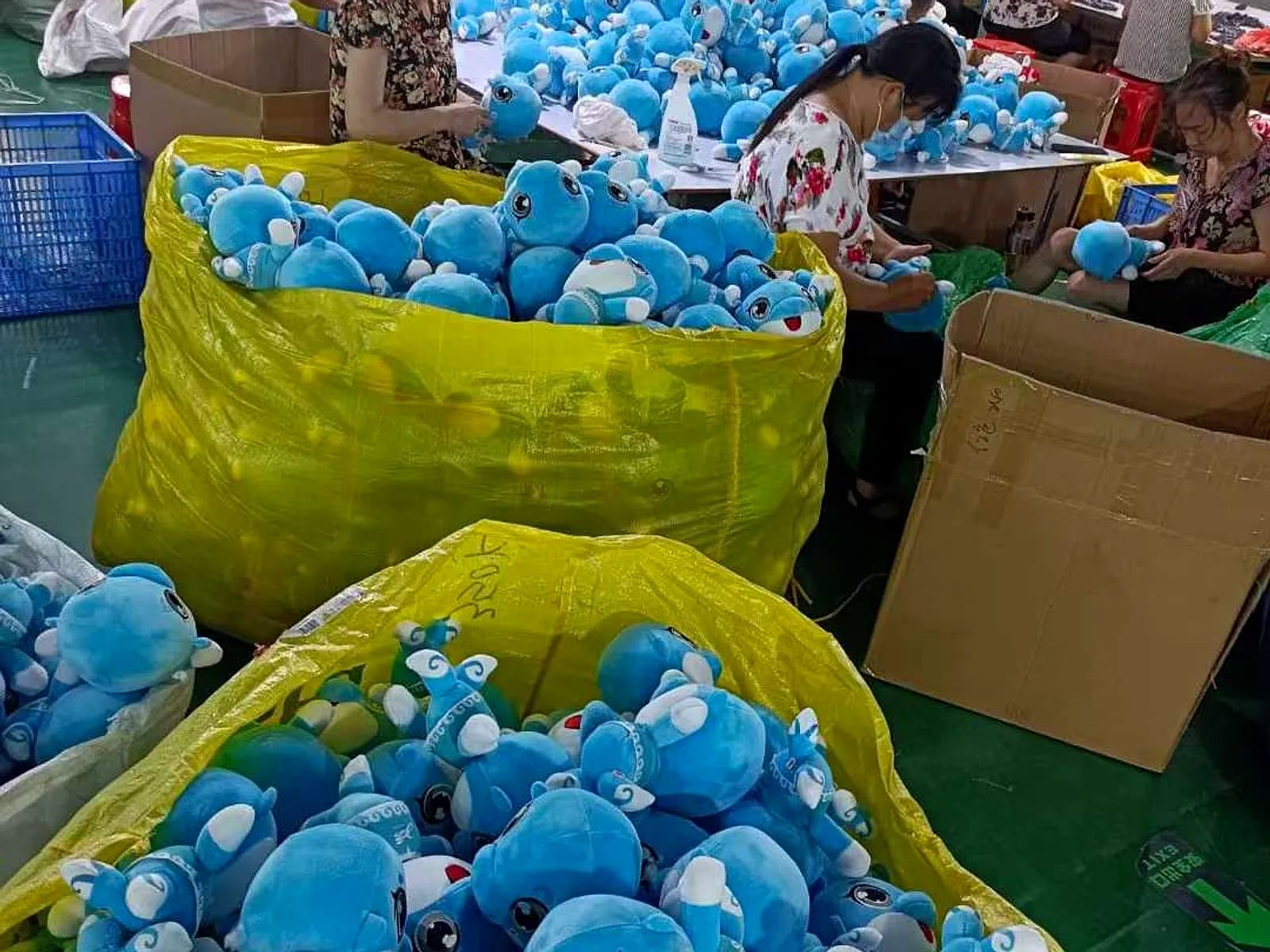
Toys are stuffed through an opening left in a seam, usually under an arm or along the back, then closed by hand with a ladder stitch. Consistency here is a training problem, and it is why factories run first-piece approval and hourly checks: fill weight drifts as an operator gets tired.
After closing, the toy is brushed to lift the pile, trimmed, and any surface lint removed. Skipping the brushing step is the fastest way to make an expensive toy look cheap in a photograph.
7. Safety testing and metal detection
Eyes, noses and any applied part are pull-tested to the force requirements of EN71-1 or ASTM F963 depending on your market. Results should be logged per batch, not per order.
Every finished piece then passes through a needle detector. Broken needles in a sewing plant are inevitable; a piece that triggers the detector must be quarantined and destroyed, not re-run through until it passes. Ask your supplier what their policy is — the answer tells you a lot.
8. Packing is part of the product
Hang tags, care labels, barcodes, suffocation warnings on polybags, age grading and importer address blocks are all regulated, and all need to be correct before printing rather than after. If your goods are going to a marketplace fulfilment centre, the labelling requirements are stricter again.
Build an extra week into your plan for packaging artwork approval. It is the step that most often delays an otherwise finished order.
Published February 11, 2025 · Updated August 4, 2025 · Custom Plush Toy Factory